
Ammo & Gear Tips
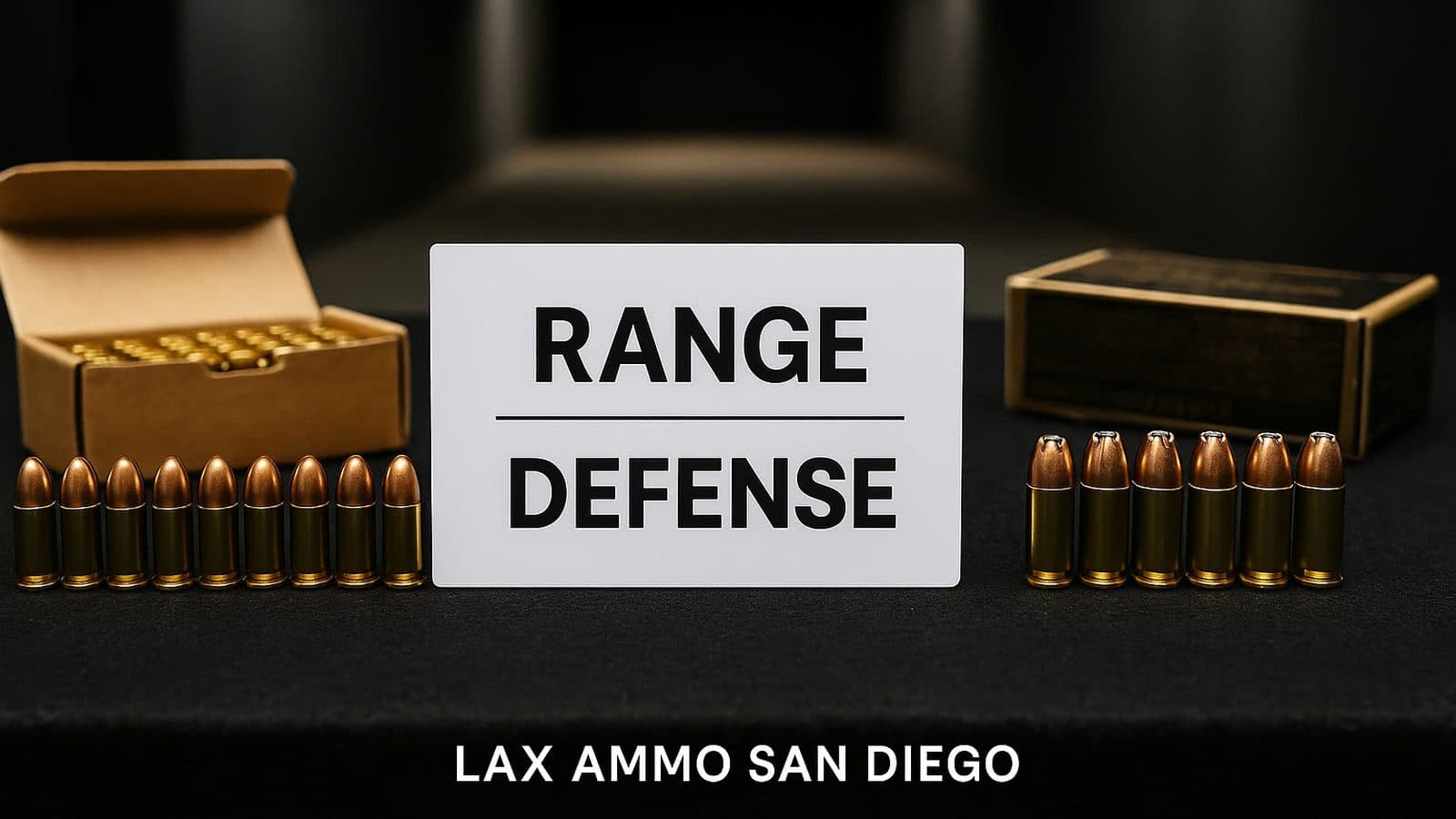
Two boxes of 9mm on the same shelf, and only one of them belongs in the gun by your bed.
The difference is the bullet. Range ammunition is almost always a full metal jacket — cheap, consistent, built to punch a hole and keep going. Defensive ammunition is usually a jacketed hollow point, engineered to open on impact so it spends its energy in the target instead of carrying it through the far wall. You can run either one through the same gun and nothing bad happens. You still shouldn't: one of them exists to be shot by the hundred, and the other exists to work once, on the worst night of your life.
What range ammo is
Range ammo, practice ammo, ball, target, plinking — same thing. A lead core with a copper-alloy jacket over the nose, in a profile that feeds out of a magazine without snagging. Everything about it is designed around two things: cost per round, and consistency across a long session. That is why it sells by the case, 500 or 1,000 rounds at a time, rather than by the box, and why remanufactured ammo loaded on once-fired brass has a real place. We keep both new and reman on the pistol shelf so you can pick by budget instead of being talked into one.
What FMJ is not built to do is change shape. The jacket holds it together, it stays close to the diameter it started at, and it keeps traveling until something stops it. Against paper and steel that is exactly right, and you should not pay a cent more for anything else.
What defensive ammo is
Defensive ammunition is usually a jacketed hollow point — JHP — with a cavity in the nose. On impact, pressure peels the jacket and lead outward into petals, and the bullet presents a much wider frontal area than it started with. Bonded designs weld core to jacket so the two do not separate after hitting something hard first. Expansion is engineered behavior inside a designed velocity window, which is why a load developed for a full-size pistol and one developed for a short barrel are genuinely different products in the same caliber.
It comes in 20- or 25-round boxes, not cases, and it is loaded in far smaller lots. The engineering, the testing and the short production runs are the whole reason a single defensive round costs several times what a bulk practice round does. You are not buying a better version of the same thing. You are buying a different job.
One California note: defensive pistol loads are handgun ammunition, and the age floor for handgun ammunition here is 21, against 18 for rifle and shotgun ammunition. The eligibility check at the counter is the same one you go through for any box, hollow point or not — our guide to buying ammo in California walks through it, and why your AFS record matters explains the one thing that decides whether that check takes two minutes or two trips.
FMJ and hollow point, side by side
- The job. FMJ: put a lot of rounds downrange affordably and consistently. JHP: transfer energy into a threat and reduce what carries on past it.
- How it is sold. FMJ by the 50-round box and the 500- or 1,000-round case. JHP by the 20- or 25-round box.
- Cost per round. Not close. A premium defensive load routinely runs several times a bulk practice load in the same caliber.
- Pressure. Many defensive loads are +P: higher pressure, sharper recoil and more flash than the practice ammo you are used to. Some are standard pressure by design, for lighter or older guns.
- How much you shoot. FMJ: hundreds per range trip. JHP: one box to prove it runs in your gun, then it sits loaded.
Three reasons not to train on your defensive load
Cost
Say it plainly: a 200-round session on defensive ammo costs what several sessions on FMJ would, so you shoot less. Fewer repetitions with expensive ammo is a worse outcome than more repetitions with cheap ammo. The skill is the thing you are buying at the range, not the cartridge.
Wear
A steady diet of +P is harder on recoil springs and frames, and in a small carry gun, on your hands. Sharper recoil across a long session also builds a flinch faster than standard-pressure ammo does, and a flinch costs far more to fix than a case of FMJ.
Availability
Defensive loads are made in small lots, and specific ones get discontinued or disappear for a year. Burn through yours at the range and you may not be able to buy that exact load again, which means re-testing whatever replaces it in your gun. Practice ammo is a commodity and comes back quickly. Your defensive load might not.
Why range ammo is the wrong choice for home defense
The interior walls of most San Diego homes are two sheets of drywall with air between them, and past that is a hallway, a bedroom or a neighbor. An FMJ that does not expand keeps most of its velocity after it goes through something, and keeps going after that. A hollow point that opens slows dramatically and is far likelier to stop inside the structure.
Be clear about how far that claim goes: no handgun bullet is guaranteed to stop in a wall, and hollow points reduce over-penetration rather than eliminate it. Anyone calling a particular load safe to shoot indoors is selling something. The point is that one option was designed with the problem in mind and the other was designed to be inexpensive.
There is a reliability reason too. Hollow-point profiles feed differently from round-nose FMJ, and a gun that runs a thousand rounds of practice ammo without a hiccup can still choke on one specific defensive load. You only learn that by shooting it.
How much of each to keep on hand
A primary defensive pistol
Roughly 200 to 500 rounds of range ammo is a sensible working stock — several real practice sessions without a trip to the store every time. On the defensive side, keep enough to fill every magazine you would actually use, plus one or two spare boxes: one to shoot for confirmation, one in reserve. That is a few boxes, not a stockpile, and it means never choosing between practicing and staying loaded.
A range gun
A .22 trainer, a competition pistol, a plinking rifle — these lean almost entirely on practice ammo, bought by the case. There is no reason to keep defensive rounds for a gun that will never be used that way, and .22 LR is still the cheapest way to build fundamentals.
A home-defense shotgun
A shotgun wants a genuine mix. Keep a couple of flats of light target loads for clays and drills, and 25 to 50 rounds of the buckshot load you have actually patterned in that gun. Slugs are a separate purchase for a separate purpose. Pattern the defensive load at 7, 10 and 15 yards, because how a shotgun spreads is specific to that barrel and that shell and you cannot look it up. Our shotgun shelf is split into bird, buck and slug for exactly that reason.
How we help you pick
Tell us the gun, the barrel length and what it is for, and we will tell you what on the shelf fits — whether a load is +P, whether there is a standard-pressure option for a lighter or older pistol, and which of what we stock sits in the family of loads agencies carry. We will happily sell you a single box to test before you commit, which is what we would do ourselves. We sell ammunition and accessories, and there is no range at our Kearny Mesa counter, so the confirming happens wherever you shoot.
Practice ammo is where the weekly in-store deals usually land, with the round count and the price published for that week. Catalog pricing moves with the wholesale market, so for anything else it is a phone call.
A plan that works, in six steps
- Pick one defensive load for your gun. Buy two boxes of it.
- Shoot one entire box, from the magazines you would actually use. You are testing the gun, the magazines and the ammunition together, not just the ammunition.
- Confirm three things: no stoppages, it hits where the sights say at 7 and 15 yards, and you can control the recoil at speed.
- Load up with the second box and keep the remainder as rotation stock. Rotate the chambered round rather than re-chambering the same cartridge dozens of times — repeated chambering can push the bullet deeper into the case.
- Buy practice ammo in volume. A 500- or 1,000-round case in your caliber covers months of range trips and costs less per round than boxes bought as you go — our bulk ammo buying guide works through when a case actually pays for itself.
- Re-shoot a box of the defensive load once a year, and any time you change the gun, the sights, the recoil spring or the magazines.
Not sure which bucket your gun falls in, or want a second opinion before spending money on a load you have never fired? Call us at 858-987-0509, text 310-499-3499, or come by the counter in Kearny Mesa — bring the make, model and barrel length and we can be useful in about two minutes. Hours, payment and what we keep in stock are in the store FAQ. Every purchase is made in person: there is no cart on this site and we do not ship ammunition. Se habla español.
Keep reading
Next Stop
The related articles, then the three pages that answer most of what people call about.
- Bulk Ammo Buying Guide: When Cases Make Sense (and When They Don't)A case is only a bargain if it is a caliber you shoot, a price that is genuinely better, and a shelf you actually have.
- New Shooter Ammo Guide for San DiegoThe caliber is stamped on your gun, plain FMJ is what you practice with, and 100 to 200 rounds is a first pistol session.
- Buying Ammo for Your First Range Trip (San Diego Edition)Plain range ammo in the right caliber, a phone call to the range first, and about twice as much as you think you need.
- The ammo catalog, by caliberPistol, rifle, rimfire and shotgun, with what each load is for and what we keep on the shelf.
- California's ammo law, step by stepThe eligibility check at the counter, the ID that works, and how to fix your DOJ record for free first.
- This week's in-store dealsFixed price, fixed quantity, this week only — redeemed at the Kearny Mesa counter.
Every purchase is made in person at the Kearny Mesa counter — there is no cart on this site, and we don't ship ammunition. Back to all articles.
Where We Are
LAX Ammo San Diego4411 Mercury St, Suite 103San Diego, CA 92111
Kearny Mesa, San DiegoOpen in Google Maps
Hours
- Mon – Fri
- 10:00 AM – 6:00 PM
- Sat – Sun
- 10:00 AM – 5:00 PM
Closed Thanksgiving Day, Christmas Day and New Year's Day.
Call or Text
858-987-0509Calls only
310-499-3499Text only
Text anytime. Anytime — immediate during business hours, forwarded after hours.
Before You Visit
- Bring your California ID — every ammo purchase needs an eligibility check.
- Purchases happen at the counter. No online checkout, and we don't ship ammo.
- Ammunition and accessories only. No firearms, no range at this location.
Se habla español
How California's ammo law works