California ammo law, in plain English
First time buying ammo in California? No problem. We'll show you what to bring and how the process works, step by step.
Status today
Is the Ammo Background Check Still in Force?
Short answer: yes. Here is where the litigation actually stands, and what would have to happen before anything changes at the counter.
The California ammunition eligibility check is in force today, and it applies to every ammunition sale in the state, including ours. If you are buying this week, nothing on this page is theoretical — bring your ID and budget for the state fee.
The rule is being litigated. In Rhode v. Bonta, a federal district court struck down the check in January 2024. A three-judge Ninth Circuit panel agreed in July 2025 — but that ruling never took effect, because the state asked the full court to rehear the case and the Ninth Circuit granted rehearing en banc, which vacates the panel decision. An eleven-judge panel heard argument in March 2026 and has not ruled.
So the honest position is: the check stands, a decision could issue at any time, and nobody can reliably predict what it will say or when. Anyone telling you the requirement has been struck down is describing a ruling that was vacated. Do not plan a purchase around it.
We update this page when something actually changes, and the eligibility check page carries the current fees and what each check involves. If a decision lands and you want to know what it means for a purchase this week, call 858-987-0509 or text 310-499-3499. We run these checks every day we are open, so we will know what changed at the counter before the commentary settles.
Changelog
What has actually changed, and when. Reviewed .
- Eleven-judge Ninth Circuit panel heard argument en banc in Rhode v. Bonta. No decision yet.
- Ninth Circuit granted rehearing en banc, vacating the July panel decision. The check remained in force throughout.
- A three-judge Ninth Circuit panel ruled against the check. That ruling never took effect and was later vacated.
- State fee for the Standard check and COE verification rose from $1 to $5. The Basic check fee was unchanged.
- A federal district court struck down the ammunition check. Stayed on appeal, so enforcement never actually stopped.
Before you drive out
What You Need to Buy Ammo in California
The short version, for anyone reading this in a parking lot. The long version, with the reasoning behind each rule, is underneath.
Bring these
- Your California driver's license or ID card. If it reads FEDERAL LIMITS APPLY, bring a passport or certified birth certificate as well.
- An address that matches your DOJ record — not just an address that is correct in real life.
- Proof of age: 18 and over for rifle and shotgun ammunition, 21 and over for handgun ammunition.
- The state's eligibility check fee. The state sets it, we collect it on the state's behalf, and it is charged per attempt.
- A little patience. Most people are approved in a minute or two, but a Basic check means coming back another day.
What the state charges
These are fees the California DOJ sets and we collect at the counter on the state's behalf. They are not our pricing, and they are separate from the cost of the ammunition.
- Standard check (AFS match)
- $5A minute or two
- COE verification
- $5A minute or two
- Basic check (no AFS match)
- $19May take several days
State fees verified against the California DOJ fee regulation on . The state changes these by regulation — it raised the Standard and COE fee from $1 to $5 on 1 July 2025 — so confirm the current figure with the DOJ before you rely on it.
Is the check still required?
Yes. As of , California's ammunition eligibility check is in full force. You may have seen headlines from July 2025 saying the law was struck down — that ruling never took effect, and it was formally vacated when the Ninth Circuit granted rehearing before a larger panel in December 2025. Buy ammunition in California today and you will go through an eligibility check and pay the state fee, exactly as you would have last year.
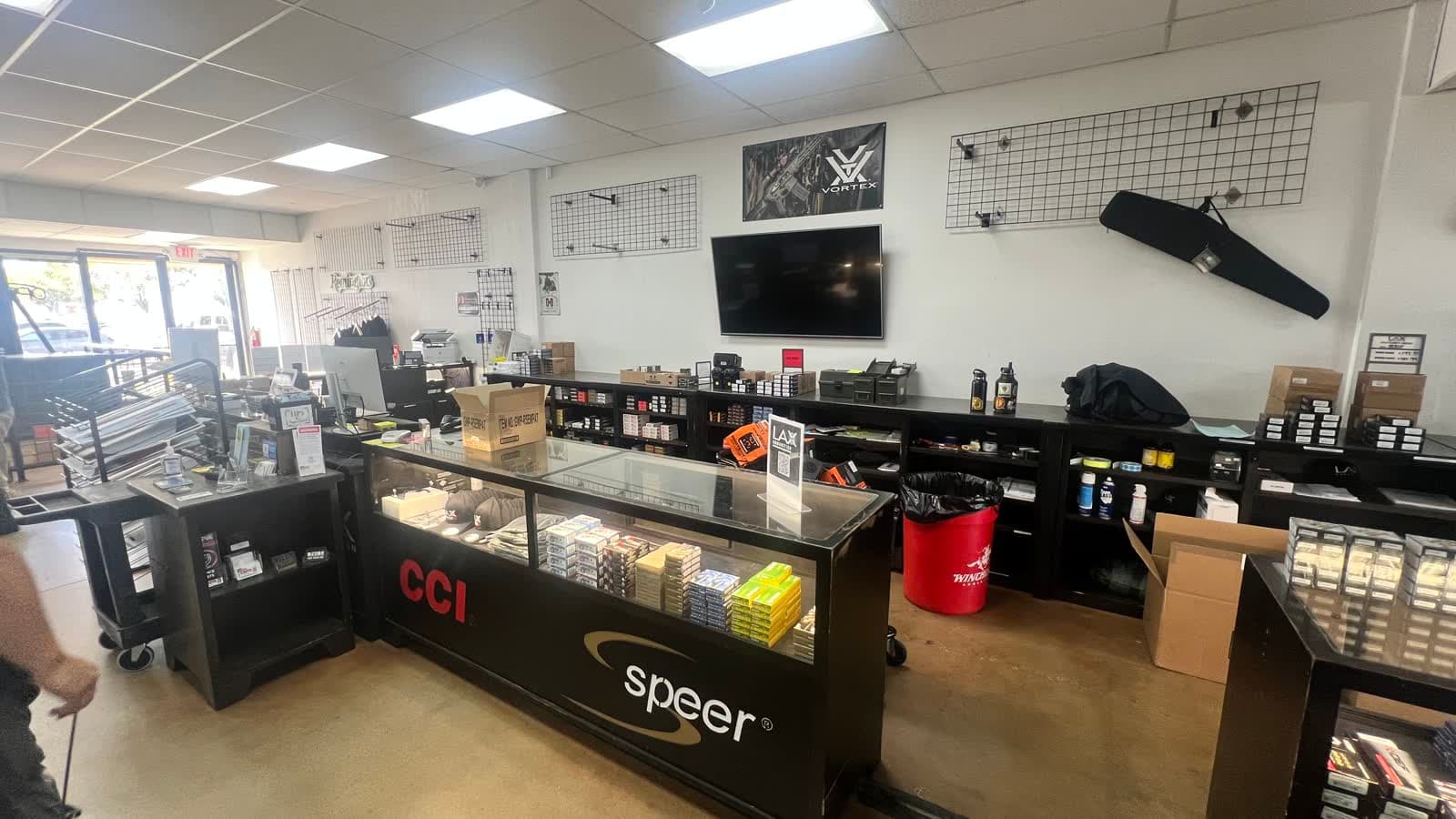
One more thing worth saying out loud before you make the drive: we sell ammunition and accessories only. No firearms, and there is no shooting range at this location. Every purchase happens face to face at our counter in Kearny Mesa — there is no online checkout on this site and we do not ship ammunition. Se habla español.
Step by step
How the Purchase Actually Works
Six steps from your kitchen table to walking out with a box. Most people are in and out; the ones who get stuck almost always get stuck on the first one.
Sort out your DOJ record before you leave the house
Log in at cfars.doj.ca.gov and check that the DOJ's Automated Firearms System has your current legal name, date of birth, address and ID number. Correcting it is free and takes a few minutes. If you have moved, changed your name, or renewed your license since you last bought a firearm, this step is the difference between a $5 state-fee check approved in a couple of minutes and a $19 state-fee check with a multi-day wait. If you have never bought a firearm through a California dealer, expect the Basic check and plan for a return trip.
Bring the right ID
Bring your California driver's license or ID card. If it says FEDERAL LIMITS APPLY in the corner, it is not a REAL ID — also bring proof of lawful presence such as a passport or certified birth certificate, and expect to bring it every visit. If the address on your ID is out of date, bring a government-issued document showing where you actually live.
Check the age rule for what you want
18 and over for rifle and shotgun ammunition; 21 and over for handgun ammunition. If you are 18 to 20 and after a caliber that works in both, such as .22 LR or 9mm, call the store first — the law permits the sale only where the vendor reasonably believes it is for a rifle, and many stores decline these as a blanket policy.
Pick your ammunition and start the eligibility check at the counter
The vendor enters your details into the DOJ system and submits the check. You pay the state-set fee at this point — $5 for a Standard or COE check, $19 for a Basic check. This fee goes to the state, is charged per attempt whether or not you are approved, and is separate from the cost of the ammunition itself.
Wait for the DOJ result
A Standard or COE check usually comes back within a minute or two. A Basic check goes to a DOJ analyst for manual review and may take several days — you will be given a tracking number and will have to return. An approved Basic check covers only that one purchase and expires 30 calendar days after approval.
Complete the sale in person
Once DOJ approves, the vendor hands the ammunition over face to face. Every ammunition transfer in California must happen in person at a licensed vendor — there is no delivery to your door, and no eligibility approval carries over to your next purchase. Next time, you start again at step four.
Eligibility checks
The Three Checks, and Which One You Get
California does not have one ammunition background check. It has three, plus a special case, and which one you land in decides both what the state charges you and whether you go home with ammunition today.
You do not choose your check — the DOJ system does, based on whether your details match a record the state already holds. That is the whole game. A buyer who has kept their record current gets a fast, cheap check. A buyer who moved two years ago and never thought about it gets the slow, expensive one, and finds out at the counter.
Standard Eligibility Check
$5 state fee
Usually a minute or two
WhoMost regular buyers — anyone whose details already match a DOJ record.
Often called the SAEC, or just the AFS match. The vendor enters your name, date of birth, current address, government ID number and phone number. DOJ checks that it matches an existing Automated Firearms System entry and does not match the Prohibited Armed Persons File. If it matches, you walk out with your ammunition the same visit.
Governed by 11 CCR 4282
Basic Eligibility Check
$19 state fee
May take several days
WhoAnyone with no AFS record at all, or whose details do not match the one on file.
A full manual background review by a DOJ analyst, comparable in depth to a firearm background check. The vendor has to collect a great deal more: name, date of birth, address, gender, hair and eye color, height, weight, ID number, phone, US citizenship status, USCIS or I-94 number where applicable, place of birth, any alias names, and race. You get a tracking number and come back later. An approval covers one purchase only and expires 30 calendar days after it is granted.
Governed by 11 CCR 4283
Certificate of Eligibility Verification
$5 state fee
Usually a minute or two
WhoPeople who already hold a current COE — firearms industry employees, licensed collectors, certain instructors. Uncommon among general retail customers.
The vendor collects the same details as the Standard check, plus your COE number. Obtaining and renewing the COE itself carries its own separate state application fee, which is paid to DOJ directly and never at an ammunition counter.
Governed by 11 CCR 4285
Firearm and Ammunition in One Transaction
No separate ammunition fee
Tied to the firearm check
WhoBuyers picking up a firearm and ammunition together at a dealer that sells both. Not something that applies here — we sell ammunition and accessories only.
There is no separate ammunition eligibility fee in this situation. You pay the firearms eligibility check fee for that transaction and the ammunition rides along on it. The catch: taking the ammunition home before the firearm check clears its waiting period means running a separate ammunition transaction, and paying the applicable ammunition check fee for it.
Governed by 11 CCR 4284
The part that catches people out
The state fee is charged per attempt, not per successful purchase. If a Standard check comes back rejected because of a records mismatch, that $5 is gone, and running a Basic check afterwards is a further $19. Both amounts go to the state. This is exactly why five minutes spent on your DOJ record before you leave home is worth more than anything else on this page.
If the check is the part you were worried about, our page on the AFS record explains what the state holds on you and how to correct it for free — and when you are ready to buy, this week's in-store deals are published with real prices.
Identification
What ID to Bring to the Counter
A valid, current government-issued photo ID — in practice, a California driver's license or California ID card. Two details decide whether that is enough on its own.
REAL ID versus “Federal Limits Apply”
Look at the top corner of your California license or ID card. If it carries the words FEDERAL LIMITS APPLY, it is not a REAL ID, and you will be asked for a second document proving lawful presence in the United States — commonly a US passport, a certified birth certificate, or naturalization paperwork. You are still eligible to buy. You just have to bring the extra paperwork, and you have to bring it every single time. Upgrading to a REAL ID at the DMV removes that friction permanently.
The address is where most people come unstuck
The address you give at the counter has to line up with what the DOJ holds for you in the Automated Firearms System. It is not enough for the address to be correct in real life — it has to match the record. If the address printed on your ID is out of date, expect to be asked for a government-issued document showing where you actually live, such as a vehicle registration, a property deed or a utility bill. Practice varies between stores on exactly which documents they accept, so call or text ahead if you are unsure. Fixing the underlying DOJ record is the durable solution, and it is free.
Two situations worth flagging
- Active duty. A military ID or Department of Defense ID number can be used in place of a California driver's license number when updating your Automated Firearms System record, which helps personnel stationed here.
- Out-of-state visitors. You can generally still buy, but almost never through the Standard check — with no California record, you are looking at the Basic check and a wait of several days, which makes a same-day purchase on a short trip unrealistic. This one depends on documentation specifics and store policy, so treat it as a call-ahead question rather than a settled rule.
Age rules
18 for Long Gun Ammo, 21 for Handgun Ammo
Two thresholds, one narrow exception in the middle, and a judgment call that legally belongs to the vendor rather than the buyer.
Under Penal Code section 30300 you must be at least 18 to buy any ammunition in California, and at least 21 to buy ammunition designed and intended for use in a handgun. Selling to anyone under 18 is prohibited outright.
The exception sits in the middle. Where a cartridge can be used in both a rifle and a handgun — .22 LR and 9mm are the everyday examples — it may be sold to someone aged 18 to 20 if the vendor reasonably believes it is being acquired for use in a rifle. Read that wording carefully: it is the vendor's judgment call, not the buyer's right, and the penalty for getting it wrong falls on the seller, up to six months in county jail, a fine, or both.
That is why a lot of California stores simply decline any dual-use caliber to anyone under 21 as a blanket policy. If you are 18 to 20 and want a dual-use round for a rifle, call us before you drive out rather than assuming the exception will be applied. Straight rifle and shotgun ammunition at 18 is not an issue.
Finally, remember these are two separate hurdles. Being over 21 does not exempt you from the eligibility check, and passing the check does not override the age rule.
The five-minute fix
AFS: The Record That Decides Which Check You Get
If you only act on one section of this page, make it this one. A stale DOJ record is the single most common reason a San Diego shooter wastes a trip and pays four times the state fee.
The Automated Firearms System — everyone shortens it to AFS — is the California DOJ's database of firearm records. It is the thing the cheap Standard check is actually checking against. Think of it as the state's list of who owns what and, more importantly for ammunition, a list of names, dates of birth, addresses and ID numbers.
Your record lands in AFS in a handful of ways: you bought a firearm through a California dealer, you registered an assault weapon, you filed a voluntary Firearm Ownership Report, you hold a CCW permit, or law enforcement entered something.
Why the cheap check fails
The Standard check is a pure data match. Your name, date of birth, current address and ID number have to line up with an existing AFS entry. Any mismatch and the transaction is denied and you are bumped to the Basic check. Two situations account for most failures:
- You moved. You updated your license with the DMV and reasonably assumed that was that. It was not. The DMV and the DOJ are separate systems, and updating one does not update the other. Your AFS record still shows the old address, the addresses do not match, and the check fails.
- You have no AFS record at all. This surprises people who genuinely do own guns. As a rule of thumb rather than a guarantee, handgun transfers have been recorded since around 1996, while long guns were not recorded in AFS until 1 January 2014. So if you bought a shotgun in 2005, inherited a rifle, or simply have not been through a dealer in decades, there may be nothing in AFS with your name on it — and no record means no match. The exact years are widely cited by California firearms attorneys rather than published on a single DOJ page, so treat them as a guide.
How to fix it, for free
If you already have an AFS record and the details are just stale, use the AFS Personal Information Update. Log in at the California Firearms Application Reporting System (CFARS), choose Automated Firearms System Personal Information Update, and correct your name, date of birth, residential address, or California driver's license, ID or military ID number. There is no fee for this. Name and ID changes require you to upload a supporting document — a license, marriage certificate, court order, birth certificate or military orders. DOJ notifies you by email or through your CFARS account, and publishes no guaranteed turnaround time, so do it well before you need to buy rather than the night before.
If you own firearms that are not in AFS at all, you can bring them onto the record voluntarily by filing a Firearm Ownership Report through the same CFARS account. That one does carry a per-firearm state fee; check the current amount inside CFARS before you file, because we would rather quote you nothing than quote you a stale number. Once it is processed, the Standard check becomes available to you.
And if you own no firearms at all — perfectly normal, plenty of people shoot rented guns at a range — there is nothing to put in AFS. The Basic check is simply your route every time, unless you obtain a Certificate of Eligibility.
The practical takeaway: five minutes in CFARS, at no cost, is what stands between an instant approval at the low state fee and a multi-day wait at the high one. Do it before you come in. If you want a hand understanding what you are looking at, call or text us — that is a conversation we have most weeks.
Stock & deal questions
Not sure which check you'll get?
Call or text before you drive out and we'll tell you what to bring, what to expect at the counter, and whether it's worth fixing your record first. It is a five-minute conversation that saves a wasted trip.
Se habla español
- Ask if your caliber is in stock today, and what it runs.
- Ask what the in-store Deal of the Week is before you drive out.
- Ask what to bring for the California eligibility check.
- Ask anything about a load, a caliber, or your gun. No pressure, no attitude.
- Phone
- immediate during business hours
- Text
- anytime — immediate during business hours, forwarded after hours
- Hours
- Mon – Fri 10:00 AM – 6:00 PM · Sat – Sun 10:00 AM – 5:00 PM
Shipping and delivery
Buying Ammunition Online in California
There is no lawful direct-to-door ammunition delivery in California. Under Penal Code section 30312, in effect since 1 January 2018, all ammunition sales, deliveries and transfers must happen face to face. You can order online — but it has to ship to a licensed California ammunition vendor, who runs your eligibility check and hands it over in person. Any website offering delivery straight to a California home address is not complying with state law.
The same logic covers road trips. Under Penal Code section 30314, a California resident may not bring ammunition bought out of state directly into California; it has to be routed through a licensed California vendor first. A first offense is an infraction and later offenses can be charged as misdemeanors. The exceptions are narrow — peace officers, licensed importers and manufacturers, certain federal licensees on the DOJ centralized list, licensed collectors holding a Certificate of Eligibility, and transfers from a spouse, registered domestic partner or immediate family member.
Our own position is simple. We are a counter, not a warehouse. Everything in our ammo catalog is bought in person in Kearny Mesa — there is no online checkout on this site, no cart, and we do not ship ammunition. Call for pricing and current stock, then come by.
If it does not go through
What a Denial at the Counter Usually Means
A rejected check is uncomfortable, and it is almost never what people assume. Here is how to read it calmly and what to do next.
Start with the base rate: most denials we see are records problems, not prohibitions. The Standard check is a data match, and a data match fails for boring reasons — an old address, a name that changed, a typo, a record that was never created in the first place. None of that says anything about you.
When a check is rejected, the vendor gives you a tracking number. Take it, keep it, and use it at the DOJ's CFARS site to see the stated reason. That reason is the only thing worth acting on — guessing at the cause is how people waste a second trip and a second state fee.
- Address or name mismatch. Fix the record through the free AFS Personal Information Update described above, then come back. This is the most common outcome by a distance.
- No record found. There is nothing to fix — you were never in AFS. The Basic check is your route, and it takes what it takes. Plan a return trip rather than waiting at the counter.
- A genuine prohibition. The check screens against the categories barred under state and federal law: felony convictions, certain violent misdemeanor convictions, outstanding warrants, active domestic violence restraining orders, and certain mental health prohibitions. If that is what came back and you believe it is a records error rather than a real prohibition, take it to a California firearms attorney. That is genuinely their work, not ours.
What we will not do, and what nobody at any counter should offer to do: work around a denial. No store can override a DOJ result, splitting a purchase does not help, and asking another person to buy on your behalf is a crime that hurts both of you. If the answer today is no, the only routes forward are fixing the record or getting proper legal advice. We will tell you which of those it looks like, and we will not make you feel small about it.
One practical note while you are here: the state fee for the failed attempt is already spent, and the next attempt carries its own. That is a state rule, not ours. It is also the whole argument for checking your record at home first — which is what the AFS record page is for.
Once the record is sorted, the rest is easy. The ammo catalog shows what we keep by caliber, and the deals board is the one page on this site that publishes prices.
Common questions
California Ammo Questions We Get at the Counter
Real questions from real customers, answered the way we would answer them in person.
I read that a court struck down California's ammo background checks. Do I still need one?
Yes. A Ninth Circuit panel did rule against the law in July 2025, and it made a lot of headlines, but that ruling never took effect and was formally wiped out when the court granted rehearing before a larger eleven-judge panel in December 2025. That panel heard argument on 25 March 2026 and has not yet ruled. Until a decision issues and the resulting order actually takes effect, checks are required at every California counter. Even if the law is eventually struck down, expect further appeals and delays before anything changes in practice.
Why did my check cost $19 when my friend only paid $5?
Because you went through different checks. Both fees are set by the state, not the store. The $5 Standard check is available only if your details match an existing record in the DOJ's Automated Firearms System. If you have no record, or your name or address does not match the one on file, the law requires the $19 Basic check instead — a full manual review by a DOJ analyst. Fixing your record at cfars.doj.ca.gov is free and moves you onto the $5 path.
I updated my address with the DMV. Why did my check still fail?
The DMV and the Department of Justice are separate systems, and updating one does nothing to the other. Your DOJ Automated Firearms System record still shows your old address, so the details do not match and the check is denied. Log in at cfars.doj.ca.gov, choose AFS Personal Information Update, and correct it. There is no fee. Do it a while before you plan to buy, since DOJ does not publish a guaranteed turnaround.
How long does the check take?
A Standard or COE check normally comes back in a minute or two and you leave with your ammunition the same visit. A Basic check goes to a DOJ analyst and may take several days — you will be given a tracking number and have to come back. If you are approved, that Basic approval covers one purchase only and expires 30 calendar days later.
Can I have ammunition shipped to my house?
No. California law requires every ammunition transfer to happen face to face. You can order online, but the ammunition has to be shipped to a licensed California ammunition vendor, who then runs your eligibility check and hands it to you in person. Any website offering direct delivery to a California home address is not complying with state law.
I bought ammo in Nevada on a road trip. Can I just drive it home?
If you are a California resident, no. Ammunition bought out of state has to be routed through a licensed California vendor before it can reach you. A first offense is an infraction, and repeat offenses can be charged as misdemeanors. There are narrow exceptions — peace officers, certain federal licensees, licensed collectors with a Certificate of Eligibility, and ammunition received from a spouse, registered domestic partner or immediate family member.
I'm 19. Can I buy 9mm for my carbine?
Possibly, but do not count on it. The law lets a vendor sell dual-use ammunition to someone aged 18 to 20 only where the vendor reasonably believes it is for a rifle, and the criminal liability for getting that judgment wrong falls on the seller. Many California stores therefore decline all dual-use calibers to under-21s as a matter of policy. Call ahead before you make the trip. Straight rifle and shotgun ammunition at 18 is not an issue.
Do I need a check to buy bullets, primers or powder for reloading?
Generally no. The Penal Code definition that triggers the eligibility check covers loaded cartridges — a primed case with propellant and a projectile. Components on their own, meaning projectiles, primers, powder and empty brass, fall outside it. Loaded reloaded ammunition is still ammunition and does need a check. Individual stores may apply stricter policies of their own, and separate rules govern storing larger quantities of powder, so ask before you plan a big order.
Is there a limit on how much ammunition I can buy at once?
There is no state-imposed quantity cap on what an individual may buy in a single transaction. Note that a separate rule took effect on 1 January 2026 requiring anyone selling more than 500 rounds in a 30-day period to hold an ammunition vendor license — that governs sellers, not ordinary buyers. Individual cities and counties can impose their own additional rules, so check locally.
Can I buy ammunition as a gift for someone else?
Buying for yourself and later giving ammunition away is not automatically unlawful, but buying on behalf of someone who is prohibited from possessing it is a crime, and California requires face-to-face transfer through a licensed vendor for sales and transfers generally. If the intended recipient is under 21 for handgun ammunition, or under 18 for anything, do not do it. If you are unsure whether a particular arrangement is lawful, ask a California firearms attorney rather than store staff.
I'm visiting from another state. Can I buy ammunition here?
Usually you can buy, but almost never on the same day. Without a California Automated Firearms System record you will be routed to the Basic check, which carries the higher $19 state fee and takes several days to clear. That makes a same-day purchase on a short trip unrealistic. Call the store before you travel to confirm what they will accept.
What actually disqualifies someone?
The check screens against the categories of people barred from owning or possessing ammunition under state and federal law — broadly, felony convictions, certain violent misdemeanor convictions, outstanding warrants, active domestic violence restraining orders, and certain mental health prohibitions. If you are rejected, the vendor gives you a tracking number you can use at the DOJ's CFARS site to find out the stated reason. If you believe it is a records error rather than a genuine prohibition, that is worth taking to a California firearms attorney.
Still stuck on something? Our general store FAQ covers hours, payment, returns and what we actually keep on the shelf, and you can always call or text the Kearny Mesa store and ask a person.
Last Reviewed and Legal Disclaimer
Last reviewed:
This page is general information about California ammunition rules, written to help you show up prepared. It is not legal advice, and reading it does not create any professional relationship. Requirements change: state fees are set by regulation and have moved before, and the litigation over the eligibility check scheme in Rhode v. Bonta is still outstanding before an eleven-judge Ninth Circuit panel that heard argument on 25 March 2026. A decision could issue at any time, and nobody can reliably predict when or what it will say. Even a ruling against the state would very likely be stayed while further review is sought, so do not plan a purchase around it.
Cities and counties can also add requirements on top of state law, so the statewide picture described here may not be the whole picture where you live. If you have an unusual situation, or a denial you believe is a records error, speak to a California firearms attorney. If anything below has changed since the review date above, the official sources win — always.
Official sources
- California DOJ — Ammunition Purchase Authorization Program
- California DOJ — ammunition purchase FAQs
- California DOJ — ammunition purchase fee regulations
- California DOJ — free AFS Personal Information Update
- CFARS — California Firearms Application Reporting System
- 11 CCR 4282 — Standard Ammunition Eligibility Check
- 11 CCR 4283 — Basic Ammunition Eligibility Check
- 11 CCR 4285 — Certificate of Eligibility verification
- Penal Code 30300 — age limits on ammunition sales
- Penal Code 30312 — face-to-face delivery requirement
- Penal Code 30314 — bringing ammunition in from out of state
- Penal Code 16150 — the legal definition of ammunition
- Ninth Circuit — status of pending en banc cases, including Rhode v. Bonta
Kearny Mesa, San Diego
Come In and We'll Walk You Through It
Nobody at this counter is going to make you feel stupid for asking how the check works. Bring your ID, bring your questions, and we'll get you sorted.
While you are planning the trip, check this week's in-store deals — they run at the counter only — or read why we opened an ammo shop in Kearny Mesa. Se habla español.
Where We Are
LAX Ammo San Diego4411 Mercury St, Suite 103San Diego, CA 92111
Kearny Mesa, San DiegoOpen in Google Maps
Hours
- Mon – Fri
- 10:00 AM – 6:00 PM
- Sat – Sun
- 10:00 AM – 5:00 PM
Closed Thanksgiving Day, Christmas Day and New Year's Day.
Call or Text
858-987-0509Calls only
310-499-3499Text only
Text anytime. Anytime — immediate during business hours, forwarded after hours.
Before You Visit
- Bring your California ID — every ammo purchase needs an eligibility check.
- Purchases happen at the counter. No online checkout, and we don't ship ammo.
- Ammunition and accessories only. No firearms, no range at this location.
Se habla español
How California's ammo law works